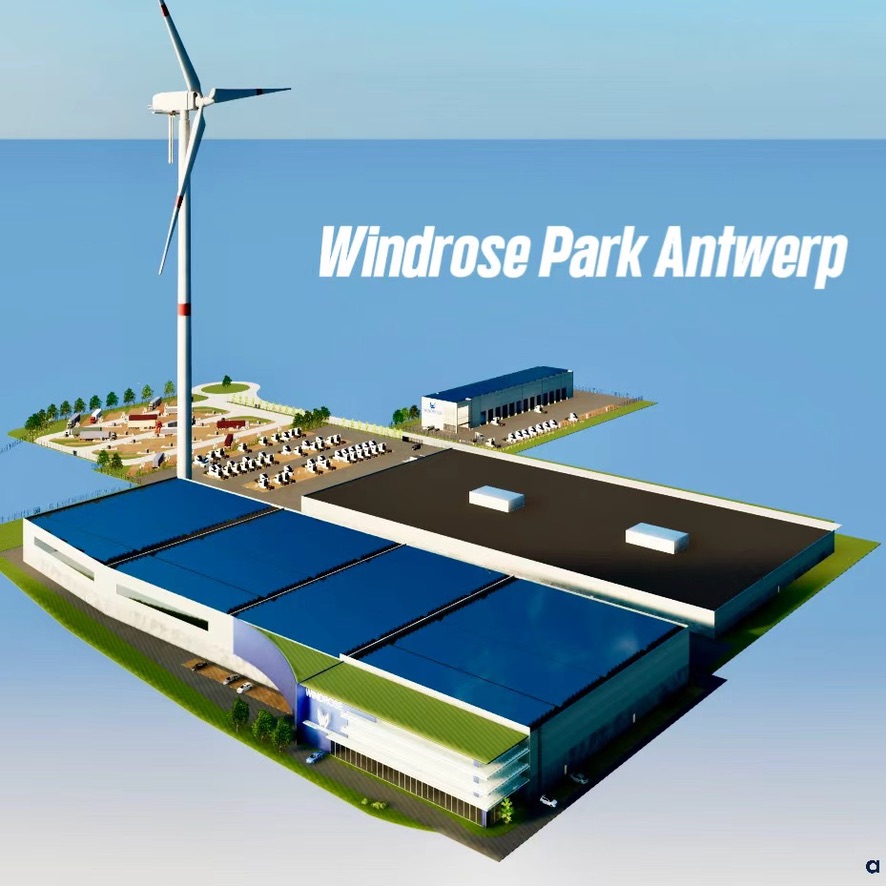
How it works
Wind Farm
⚡ Charges
Power
Ships to site
Site
Through a grid PCS: truck chargers,
site load and grid services
site load and grid services
Windrose Power1.41 MWh1C · 1.4 MW
Inside the Container
Each string is one E700: 4 packs and 705 kWh, with that truck's distribution unit and controller.
| Part | Qty | What it does in the container |
|---|---|---|
| LFP battery pack | 8 | 176.3 kWh, 766 V nominal, 238 cells in series, 2,800 × 1,081 × 269 mm, 1,146 kg. Each pack has its own service disconnect. |
| Power distribution unit | 2 | 600 A main contactor, precharge, insulation monitoring and a 24 V / 6 kW DC-DC converter for each string. |
| Vehicle controller | 2 | Wakes the pack monitors, sequences the contactors, supervises the battery and talks to the PCS. |
| Battery thermal unit | 2 | 12 kW of cooling each, with a high-voltage compressor powered from the battery. |
| Coolant heater | 2 | 12 kW each, one per thermal unit. |
| Coolant pump and filter | 2 | One set per thermal unit. |
| Expansion tank | 1 | 5 L + 5 L, on the highest point of the return line. |
| High- and low-voltage harnesses | — | Truck harness designs, cut to the container's lengths. |
| 24 V battery | 2 | Two in series, as in the truck. |
New for the container: automatic fire suppression with smoke and off-gas detection, DC wall bushings, the container conversion and the pack frame.
Thermal Management
Each pack has its own supply and return branch (DN20) with isolation valves. The branches feed one riser per column (DN25) and a header along the roof (DN32). The two thermal units run in parallel, each with its own pump and heater. The expansion tank sits at the highest point of the return line, and the power distribution units are cooled from the same loop.
Certification
| Scope | Standard | Status |
|---|---|---|
| Battery pack — transport | UN 38.3 | Held |
| Battery pack — vehicle safety | UN ECE R100.03 — E24*100R03/02*0309*00 | Held |
| Container — EU Battery Regulation | (EU) 2023/1542: Annex V stationary storage safety, CE marking | In preparation |
| Stationary storage safety | EN IEC 62619 · IEC 62933-5-2 | In preparation |
| Large-scale fire test | UL 9540A, unit level | Planned |
| Electrical | Low Voltage Directive 2014/35/EU · EMC Directive 2014/30/EU | In preparation |
| Battery data | Performance parameters and read-only state-of-health access (Art. 10, 14); EU battery passport from 18 Feb 2027 | In preparation |
| Transport — whole container | UN 3536, ADR / IMDG special provision 389 — shipped fully assembled at 30–50 % state of charge | Applies |
| Grid connection | Through a PCS on the Synergrid C10/26 list, EN 50549 | PCS supplier |
| Site permit (Flanders) | VLAREM II chapter 6.13 | Per site |
Producer and EU manufacturer: Windrose Technology Antwerp N.V.
Battery Chemistry
Power uses LFP (Lithium Iron Phosphate) — the safest, longest-lived lithium-ion chemistry. Here's how it compares to NCA (Nickel Cobalt Aluminum), used in many stationary storage systems.
Power · Battery Chemistry
LFP
Lithium Iron Phosphate
NCA · Battery Chemistry
NCA
Nickel Cobalt Aluminum
Inside the Battery — LFP vs NCA
Cell Cross-Section — Cathode (+) Top · Anode (−) Bottom
Cathode Crystal Structure — Where the Elements Live
LFP — Olivine Structure
LiFePO₄
Li sits in channels between FePO₄ layers. O is locked inside PO₄ tetrahedra — cannot escape, even above 270 °C.
NCA — Layered Oxide
LiNi₀.₈Co₀.₁₅Al₀.₀₅O₂
Li alternates with Ni/Co/Al-O layers. O is held by weaker ionic bonds — releases above ~150 °C, igniting the electrolyte.
Battery Lifetime: LFP vs NCA
At one full charge/discharge cycle per day, LFP reaches 8,000+ cycles in over 20 years with minimal capacity fade. NCA chemistry degrades faster under heavy daily cycling, typically reaching end-of-life around 8 years. LFP also releases far less heat and gas if a cell fails — a critical safety advantage for outdoor storage.
Specification Sheet
| Category | Item | Parameters |
|---|---|---|
| Battery | Capacity | 1.41 MWh (8 × 176.3 kWh) |
| Cell | LFP, 230 Ah prismatic | |
| Packs | 8 × Windrose truck LFP pack, 238 cells in series | |
| Configuration | 2 strings × 4 packs = 2 × Windrose E700, 705 kWh each | |
| DC Interface | Voltage Range | 595–869 V DC (766 V nominal) |
| Design Rate | 1C continuous (≈ 1.4 MW DC) | |
| Outputs | 2 independent DC strings to the PCS | |
| String Protection | 600 A main contactor, precharge, insulation monitoring | |
| Thermal | Cooling | 2 × 12 kW, liquid |
| Heating | 2 × 12 kW | |
| Auxiliary Power | 24 V from on-board DC-DC, 6 kW per string | |
| Safety | Fire Protection | Automatic suppression, smoke and off-gas detection |
| Service Disconnect | On every pack | |
| Size & Weight | Container | 20 ft standard, not high-cube: 6,058 × 2,438 × 2,591 mm |
| Battery Mass | 9.2 t (8 × 1,146 kg) | |
| Grid | Power Conversion | External PCS (EN 50549, Synergrid C10/26) |
Contact us — we'll size Power for your site, PCS and grid connection.
Contact Windrose →