After-Market · Recovery
Recovery & Emergency Response
Procedures for first responders, tow operators and recovery specialists handling a Windrose electric truck in an incident, breakdown, fire or submersion event. The official Windrose Emergency Response / Rescue Guide and the Towing / Recovery / Transportation / Storage Guide follow below.
1. Emergency Response / Rescue Guide
Official Windrose emergency response and rescue procedures for first responders. Document reference WINDROSE-202408-001 (Version 01) — applies to all Windrose vehicles from 2024 onward.
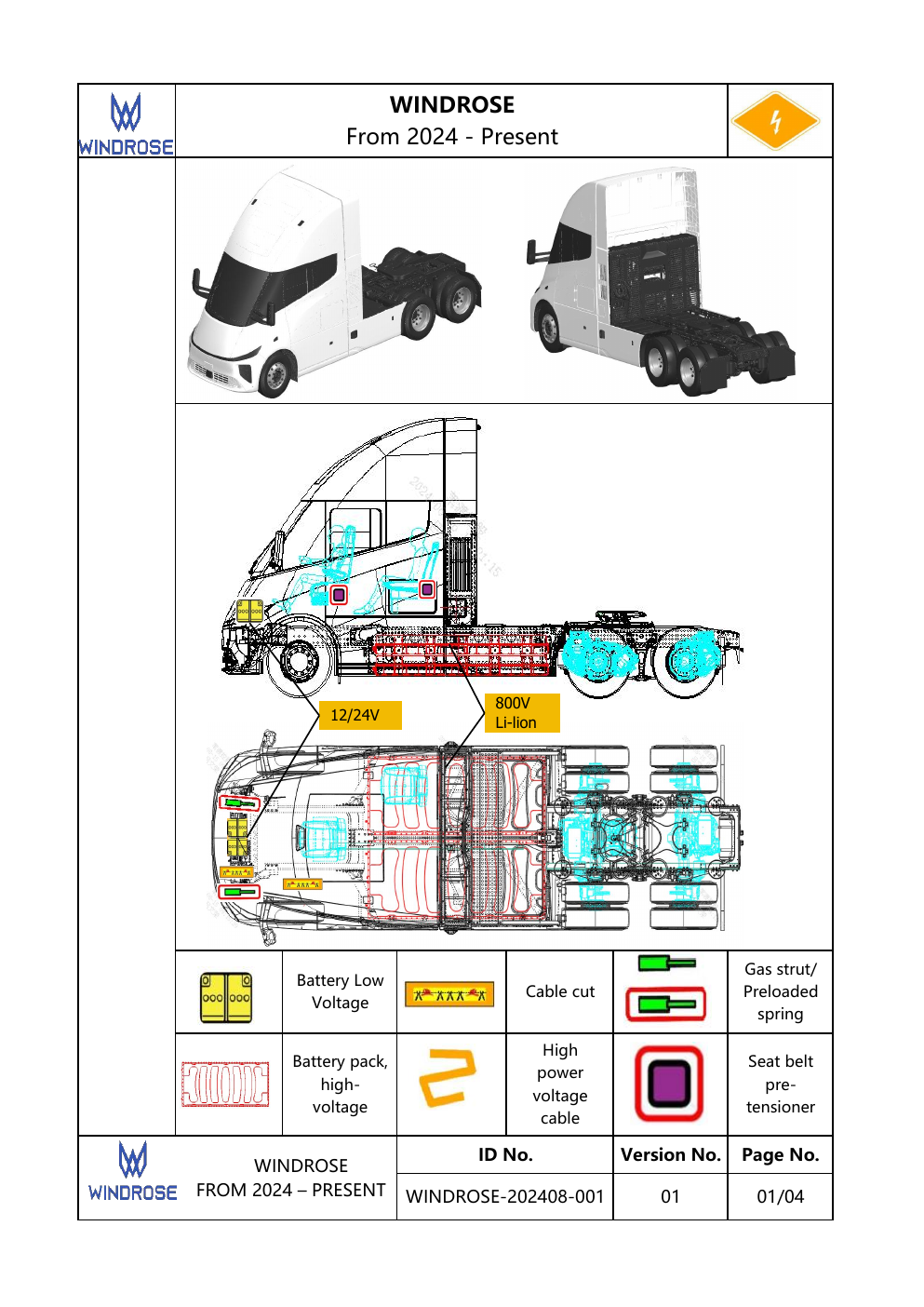
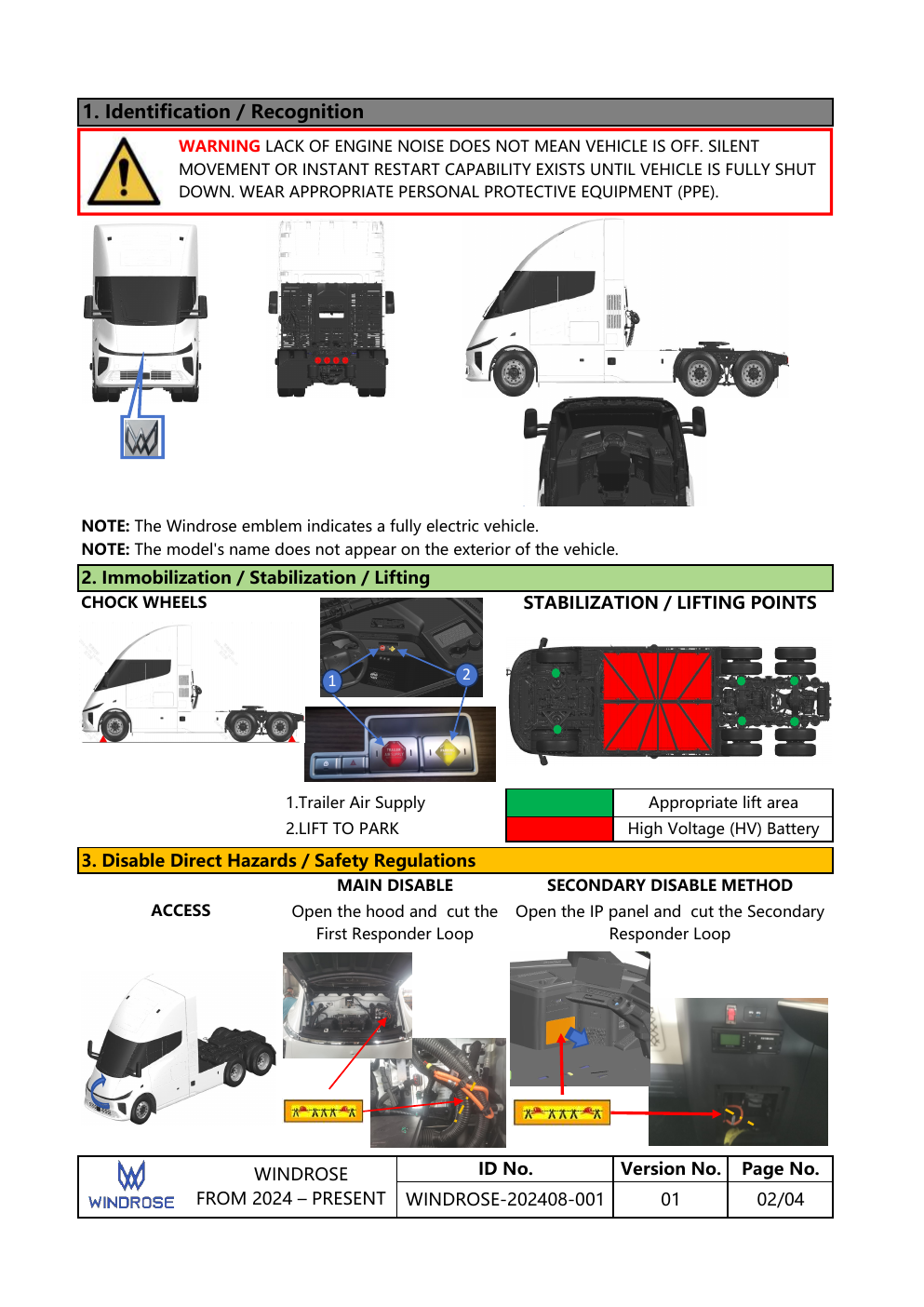
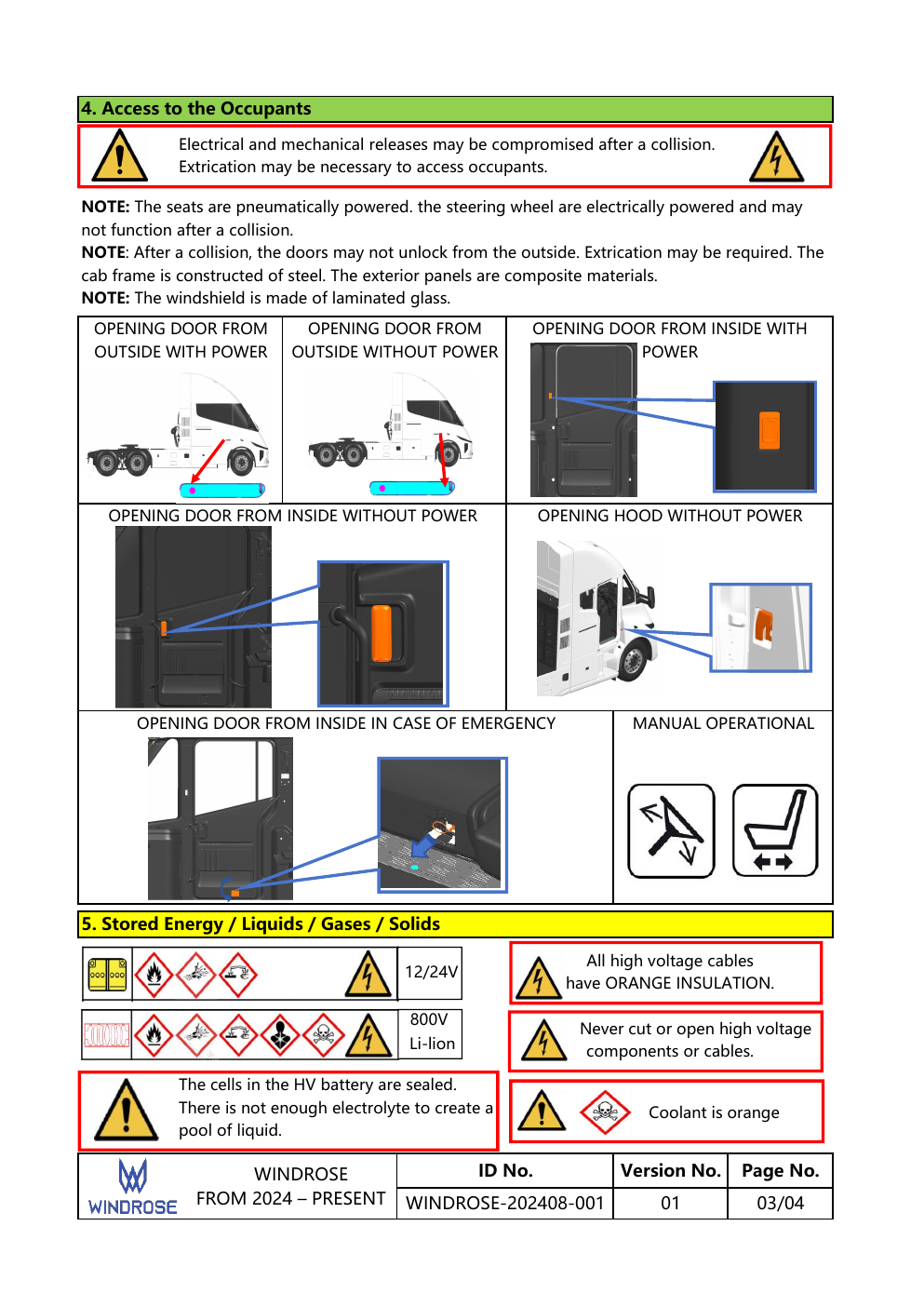
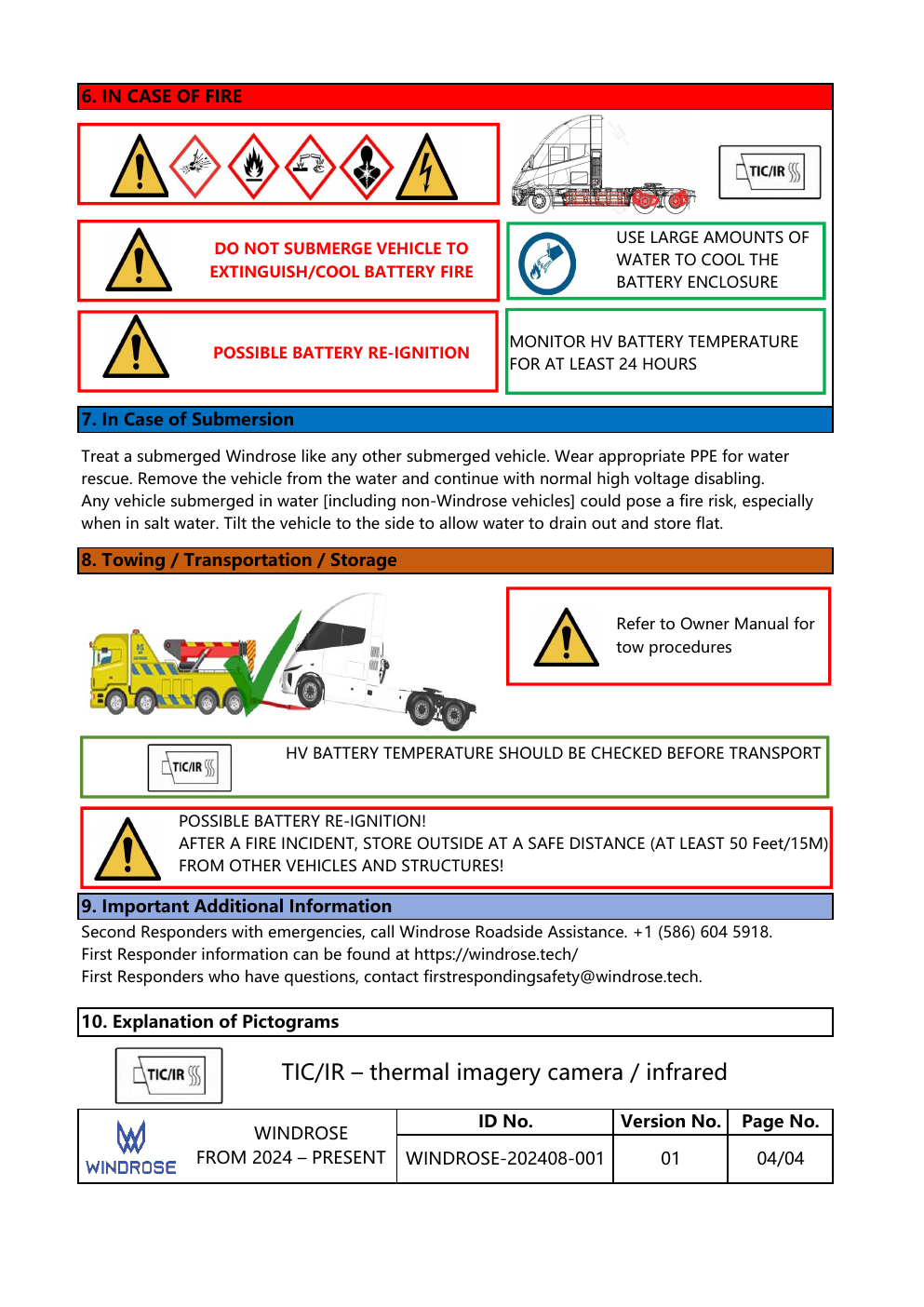
§1 — Identification / Recognition
The Windrose emblem indicates a fully electric vehicle. The model's name does not appear on the exterior. Key energy indicators on the vehicle:
- 12/24VBattery — low voltage
- 800VHigh-voltage Li-ion traction battery
- CutCable cut zone (gas strut / preloaded spring)
- ⚠Battery pack — high voltage · high-power HV cable
- ⚡Seat-belt pre-tensioner (pyrotechnic)
§2 — Immobilization / Stabilization / Lifting
Chock the wheels. Stabilize and lift using the marked chassis / battery-pack lift points only. Standard heavy-truck stabilization methods apply.
- 1Trailer air supply
- 2Lift-to-park point
- 3Appropriate lift area — avoid the HV battery enclosure
§3 — Disable Direct Hazards / Safety Regulations
Disable the high-voltage system using the First Responder Loop. Two independent methods are provided.
- APrimary: Open the hood and cut the First Responder Loop.
- BSecondary: Open the IP (instrument panel) and cut the Secondary Responder Loop.
§4 — Access to the Occupants
- The seats are pneumatically powered; the steering wheel is electrically powered and may not function after a collision.
- After a collision the doors may not unlock from the outside — extrication may be required.
- The cab frame is steel; exterior panels are composite materials.
- The windshield is laminated glass.
Procedures for opening each door (with power, without power, from inside, emergency interior release) and the hood (without power) are shown in the guide above.
§5 — Stored Energy / Liquids / Gases / Solids
| Item | Detail |
|---|---|
| 12 / 24 V system | Conventional low-voltage battery — disconnect as usual. |
| 800 V traction battery | Lithium-ion (LFP). Cells are sealed — not enough electrolyte to form a pool. |
| HV cables | ORANGE INSULATION. Never cut or open HV components or cables. |
| Coolant | Orange — non-conductive coolant loop for HV battery and power electronics. |
| Air springs / preloaded springs | Pneumatic stored energy — release per OEM procedure. |
| Seat-belt pre-tensioners | Pyrotechnic — deploy once on impact; do not cut after deployment. |
§6 — In Case of Fire
- 1Use large amounts of water to cool the battery enclosure.
- 2Monitor the HV battery temperature for at least 24 hours.
- 3Possible battery re-ignition — secure the area.
§7 — In Case of Submersion
Treat a submerged Windrose like any other submerged vehicle. Wear appropriate PPE for water rescue. Remove the vehicle from the water and continue with normal high-voltage disabling.
Any vehicle submerged in water — including non-Windrose vehicles — could pose a fire risk, especially when in salt water. Tilt the vehicle to the side to allow water to drain out and store flat.
§8 — Towing / Transportation / Storage
Refer to the Owner Manual for tow procedures. See §11 below for the complete Windrose towing / recovery / transportation / storage procedure.
§9 — Important Additional Information
- ☎Second responders with emergencies: Windrose Roadside Assistance +1 (586) 604 5918.
- ✉First-Responder information portal: https://windrose.tech/
- @First Responders with questions: firstrespondingsafety@windrose.tech
§10 — Explanation of Pictograms
The pictogram legend used throughout the guide — including TIC / IR (thermal imagery camera / infrared), PPE, electrical hazard, lift points, cut zones and stored-energy markers — is reproduced on page 4 of the document above.
2. Towing / Recovery / Transportation / Storage
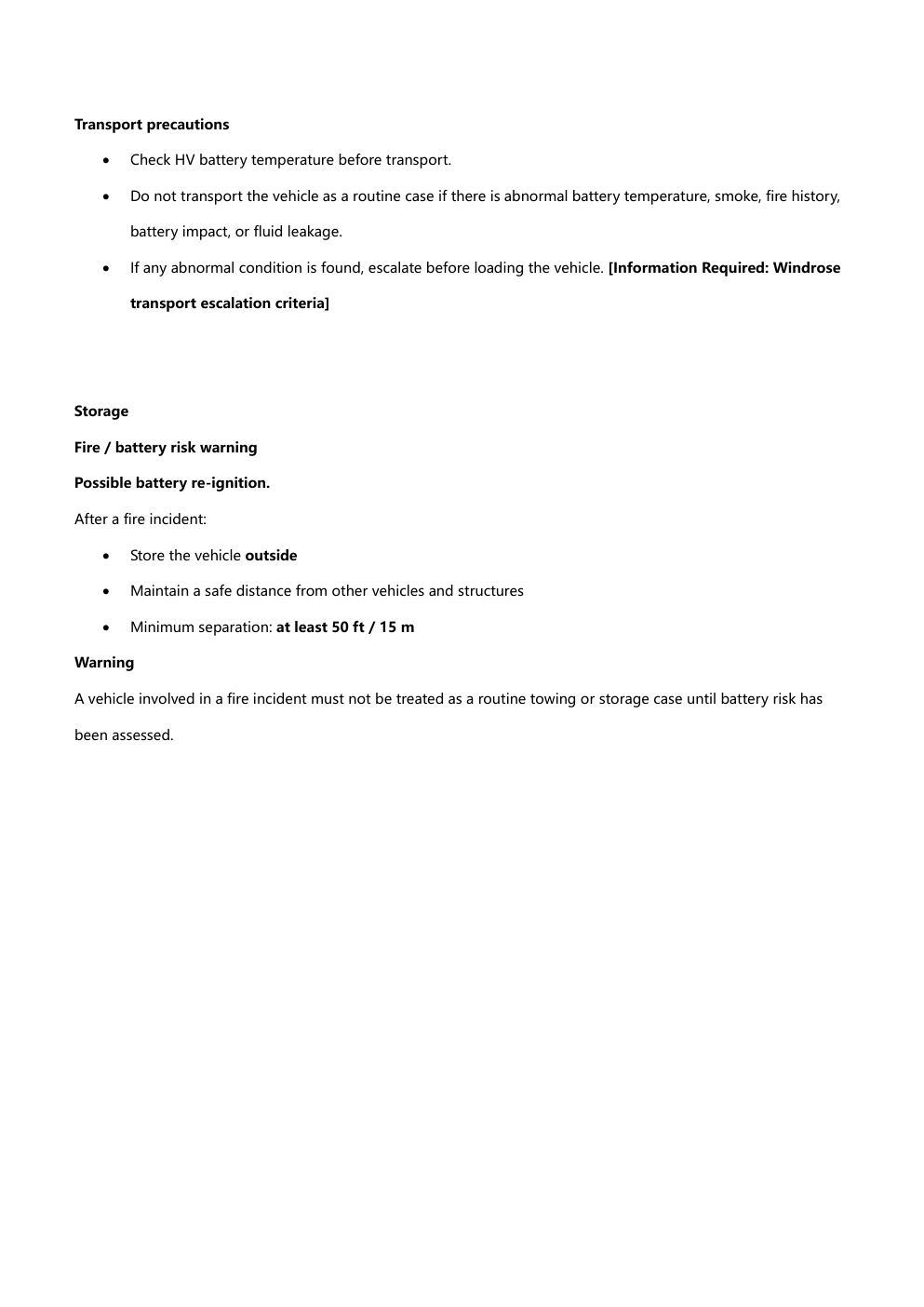
Official Windrose towing, transportation and storage procedures for recovery operators. Front-towing only; rear towing is not an option on this platform.
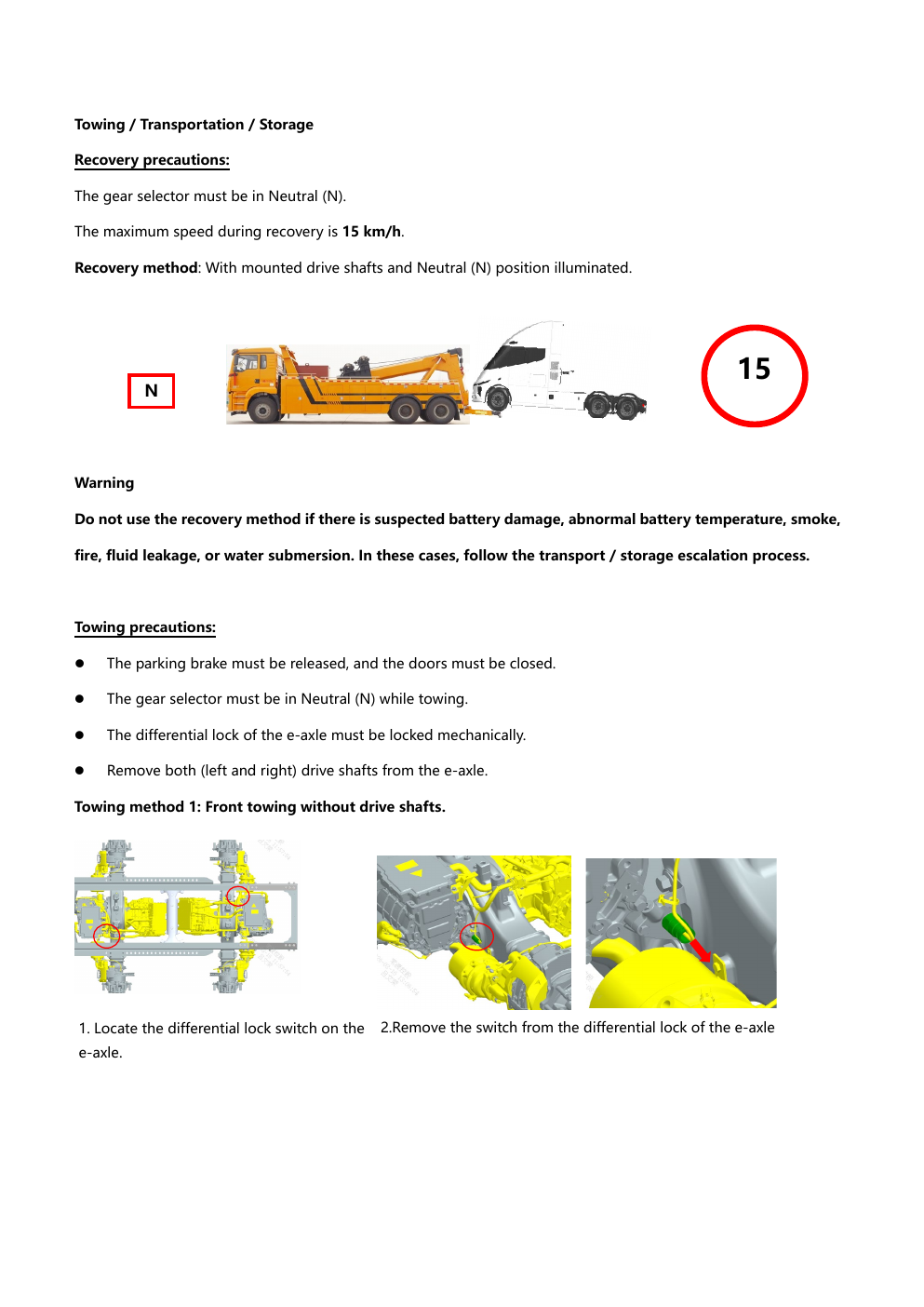
Recovery Precautions
- NThe gear selector must be in Neutral (N).
- 15The maximum speed during recovery is 9 mph.
- ⚙Recovery method: with mounted drive shafts and Neutral (N) illuminated.
Towing Precautions
- The parking brake must be released, and the doors must be closed.
- The gear selector must be in Neutral (N) while towing.
- The differential lock of the e-axle must be locked mechanically.
- Remove both (left and right) drive shafts from the e-axle.
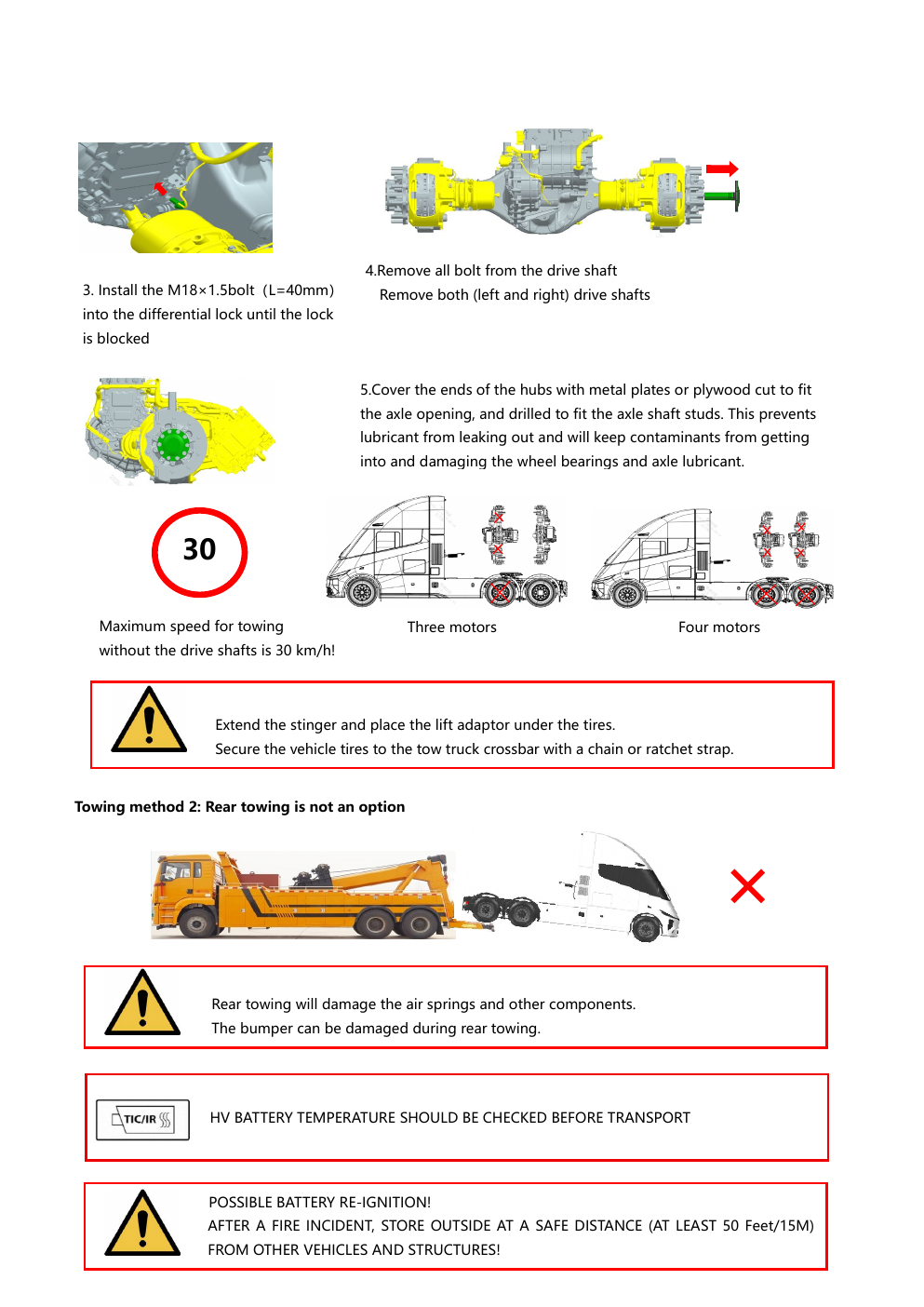
Towing Method 1 — Front Towing Without Drive Shafts
- Locate the differential-lock switch on the e-axle.
- Remove the switch from the differential lock of the e-axle.
- Install the M18 × 1.5 bolt (L = 40 mm) into the differential lock until the lock is blocked.
- Remove all bolts from the drive shaft. Remove both (left and right) drive shafts.
- Cover the ends of the hubs with metal plates or plywood cut to fit the axle opening, drilled to fit the axle-shaft studs. This prevents lubricant from leaking out and keeps contaminants out of the wheel bearings and axle lubricant.
Extend the stinger and place the lift adaptor under the tires. Secure the vehicle tires to the tow-truck crossbar with a chain or ratchet strap.
Towing Method 2 — Rear Towing Is NOT an Option
Transport Precautions
- Check HV battery temperature before transport.
- Do not transport the vehicle as a routine case if there is abnormal battery temperature, smoke, fire history, battery impact, or fluid leakage.
- If any abnormal condition is found, escalate before loading the vehicle. Information required: Windrose transport escalation criteria.
Storage
- After a fire incident: store the vehicle outside.
- Maintain a safe distance from other vehicles and structures.
- Minimum separation: at least 50 ft.